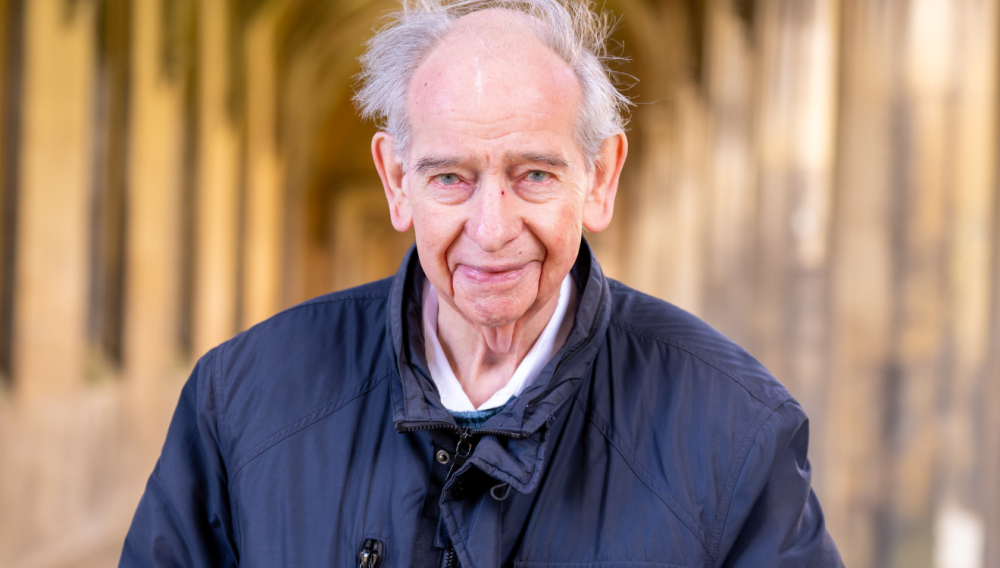
The University of Cambridge Faculty is sad to announce the death of our valued colleague, Professor John Iliffe, Emeritus Professor of African History (1 May 1939 – 20 August 2026).
John Iliffe played a pioneering role in establishing the field of African history in the UK. After studying History as an undergraduate at Peterhouse, he completed his PhD in 1965 on the German colonial administration in Tanganyika (East Africa). John then took up a teaching post at the University of Dar es Salaam in recently independent Tanzania. This experience was foundational to his perspective on the African past, which was deeply concerned with the lived experience of African peoples.
As his close friend and colleague, Emeritus Professor John Lonsdale, writes: “Nobody has done more than John Iliffe to deepen and widen our understanding of African history. His range of interests, his mastery of evidence from such an exhausting array of archival sources and unpublished dissertations, not only in English but also in French and German, were truly astonishing, thanks to the legendary length of the hours he spent at work, with pencil and note-cards, not with smartphone—and writing not on keyboard, but with typewriter. On top of astonishment, however, it is the humanity of John’s insights that strike deepest.
“His Modern History of Tanganyika (1979), written all those years ago, is still the best national history of any new African state. He tackled such a humane variety of historical topics: African famine, African capitalism, the many different senses of African honour, political biography, the birth of the East African medical profession, the suffering and endurance of the African poor over the centuries, the AIDS epidemic, as well as his absolutely essential Africans: The History of a Continent—from the origins of humankind to the present day—first published in 1995 and now in its third edition. This was African history for the world, ignorant of how much it owed to Africans, whom John called, memorably, ‘the frontiersmen of mankind’.
“Countless undergraduates and a score or two of doctoral students flourished under his devoted supervision. I myself learned from him how to lecture with greater clarity and effect, and how to conduct seminar classes in which, together at Cambridge, we taught as “the two Johns”: a first-year Themes and Sources paper on African Christianity, from miracle-working Ethiopian saints to Bishop Desmond Tutu, and a third-year Special Subject on the history of Urban Apartheid. Never have I had to work so hard in order to keep up with a colleague!
“African history owes John a staggering debt in his sheer curiosity, his extraordinary appetite for gruelling hard work, his courage in publishing in so many areas of others’ expertise, and perhaps above all in his intellectual capacity to lodge intimate human anxieties, hopes, obligations, determination and expectation in long spans of continental-wide change and continuity. To those who had the good fortune to know him, he will be sorely missed. And future scholarly generations who will never know him personally, will, so long as reading continues, benefit from engaging with his thoughts, always expressed in such clear and uncomplicated prose.”
Returning to Cambridge in 1971, John was appointed Assistant Director of Research in the History Faculty and was simultaneously elected a Fellow of St John’s College. By 1980, he was Reader in African History and was promoted to Professor a decade later. In these roles he taught African history to generations of lucky students until his retirement in 2006, instilling in them his meticulous attention to detail and his extraordinarily insightful understanding of the African continent, past and present. John’s legendary Part II undergraduate paper, ‘The History of Africa from 1800 to the Present Day’, remained on the curriculum for more than five decades and he also supervised numerous PhD students.
Another colleague, former Smuts Professor Megan Vaughan, remembers meeting John when a junior lecturer at the University of Malawi in the early 1980s: “I had just finished my PhD and I had read as much of his work as I could get my hands on. I was very excited. I don’t know exactly what I expected, but when John arrived in Zomba I was quite surprised. I knew that he had been at the University of Dar es Salaam in its heady days. But there was definitely no sign of the colourful afro shirt so beloved of male white Africanists at the time. John was dressed quite formally in a tweedy jacket that looked unsuitable for the climate, and he seemed older than I had envisaged. Somehow this didn’t fit with my reading of his lively, sensitive writing, which only speaks to my own lack of imagination.
“John’s main commitment over the couple of months of his visit was to deliver a set of lectures to the undergraduates in our department. This he did with the utmost professionalism and sensitivity and with not a trace of condescension. As I remember it, these lectures were really a kind of rehearsal for his landmark textbook on the history of the continent. Influenced by the Annales school, they covered a broad sweep of environmental, social and demographic history. Though underpinned by a set of structural arguments, they were also enlivened by his deep interest in African political and social systems, by real people and their inventiveness, sometimes their struggles. Students and staff were completely riveted. Without sacrificing complexity, John constructed inspiring lectures that were models of clarity which just left one wanting for more. John also spent time in the Malawi National Archives, writing in that neat hand on the record cards for which he became legendary. The Presidential palace was and is next door to the archive building and when the President (Hastings Kamuzu Banda) was driven in and out waving his fly whisk from his open top Bentley, readers were firmly encouraged to join the staff in lining up outside and clapping as he rode by. John politely declined to do this – not, I think, as an act of political resistance, but because he refused to sacrifice even a minute of precious time in the archive.
“Decades later, when I joined the Cambridge History Faculty, John was unfailingly kind and helpful to me. He carried on giving outstanding lectures; he was devoted to his graduate students and very proud of their successes. Most of all, we will all remember John for the extraordinary scholarship to which he dedicated his life. The depth and breadth of his knowledge of African history was unmatched. He never eschewed complexity and he dealt head-on with difficult and painful periods of African history, but his scholarship was always marked by his strong belief in our shared humanity.”
Associate Professor Ruth Watson, who joined the History Faculty in 2006, also remembers John: “for his kindness and generosity. My first few years in Cambridge were challenging, and John gave me unwavering support. He was a giant in the field of African history, but he never sought to be celebrated, quite the opposite. His guidance, always wise, was delivered in such an unassuming way. It was both a delight and an honour to be in his presence.”
The following tributes from former students remember John’s inspiring teaching:
Robert Ross, Professor Emeritus in African Studies, Leiden University, who was John’s first PhD student, recalls: “Despite his phenomenal erudition, which made him a sharp but very fair research supervisor, John would never dominate a gathering. For him, it was vital that the processes of academic discussion always continued. He was particularly good at elucidating the contributions and opinions of younger participants. These sessions were always friendly, but sometimes with a twist in the tail. When he gave himself the time to relax, John loved thrillers and for that matter the churches of his native East Anglia.
“In his first year or so back from Africa, supervisions were often continued, or begun, in a village pub near Cambridge, and once, memorably, watching cricket at Lords. Later, his suggestions were closer to the Stakhanovite regime he imposed on himself.”
Professor Nigel Worden, formerly King George V Chair in the Department of Historical Studies at the University of Cape Town writes: “Many people, including my Director of Studies, thought that my choice in the mid-1970s of the Part II paper in African History was eccentric and foolhardy. On the contrary, it was the best decision I ever made. This was a new and vibrant field of study. But the greatest allure was that it was taught by a young and enthusiastic lecturer, recently returned to Cambridge from Tanzania, John Iliffe.
“John was my ideal of a university academic. Original and pathbreaking in his scholarship, he was sensitive and sympathetic to the perspectives and needs of newly independent Africa, while transcending what then was the somewhat ponderous weight of both postcolonial triumphalism and abstract theorization.
“But John was more than this. He was also an outstanding teacher and mentor. In every lecture, seminar and supervision he treated us naïve undergraduates as if we were his equals. We thus swiftly learned to share his passion for Africa and to engage with its complexities. And many of us were inspired by him to become historians of Africa ourselves, benefitting hugely from his engagement with us as research supervisor, his active support for our later careers, and his steady friendship. It is no exaggeration to say that in so doing, John changed our lives.”
Vivian Bickford-Smith, Emeritus Professor of History at the University of Cape Town and Extraordinary Professor at the University of Stellenbosch recalls: “John Iliffe’s teaching persuaded me not to become a lawyer. My change of mind was directly the result of attending his undergraduate lectures in African history. John was able to synthesise seemingly a whole rolling stack of University Library books into a single, well-constructed and intelligible lecture. His intelligence, always worn so lightly, was of the kind that translated complex ideas into readily understandable language. He preferred to make the complex simple rather than turning the simple into the unnecessarily complex. This was instructive, and rightly an implicit instruction, for his students. Yet one soon discovered that John was always encouragingly interested in almost everything, constructively critical without being patronising, whatever the crumbs you put before him.
“In short, John was a superb teacher and one was immensely fortunate indeed to have been his student. As a PhD supervisor he offered wise mentorship and kindness. For someone who worked so famously hard, John nonetheless always found time for his postgraduate students: a drink in his room perhaps, or dining in hall, or a pint or two at the Baron of Beef; he once kindly took my wife and I on a memorable tour of the wool churches of Suffolk. This generosity was coming from someone who, despite his love of cricket, was rumoured to allow himself only 45 minutes when watching a game at Fenners.”
Dr Wayne Dooling, SOAS, University of London, writes: “As all historians of Africa know, John Iliffe covered the continent unlike anybody else. East Africa, of course, was his first passion and primary area of expertise but, to the great benefit of his students of South African history, he had a special fondness for southern Africa. His interest in the subcontinent extended to spells of archival research in Zimbabwe, Malawi and South Africa. He criss-crossed South Africa by car, driving thousands of kilometres to see the apartheid geography of Soweto first-hand, visit the Kruger National Park, and, not least, to spend time at the Newlands cricket ground. He loved Karoo hotels – his favourite, he told me, was the Drostdy Hotel in Graaff-Reinet. I was astounded to discover that he had visited the Moravian Mission Station at Wupperthal, an impossible-to-reach settlement hidden deep in the Cederberg mountains of the Western Cape. During my time as a PhD student in Cambridge, he convened a seminar series exclusively dedicated to the history of southern Africa. These meetings were the highlight of my week. Above all, it was John’s humility, generosity and kindness that allowed me to navigate an environment I otherwise found thoroughly alienating.
“As a supervisor, John was encouraging and exacting in equal measure. He set an extremely high bar and seemed genuinely surprised that others could not match his capacity for hard work and speed of writing. Our supervisions were always a joy, however. I never ceased to marvel at his knowledge of the African past – and present. There never seemed to be a topic about which he didn’t know something, or on which he wasn’t able to produce a bibliographic index card from a shoebox at the speed of light. But supervisions were much more than that. He frequently allowed conversation to wander beyond the topic of the particular draft chapter under discussion, occasionally sharing small but interesting details of his personal history, his views on the nature of university, and his (unfortunately premature) predictions on the future ethnic composition of the England cricket team. On one occasion, I happened to tell him that I was born in Cape Town’s Somerset Hospital. He cocked his head to one side, pondered for a few seconds, and simply said, ‘Yes, you would’ve been.’ Such was his knowledge of the African continent!”
Professor Clive Glaser, University of the Witwatersrand, remembers feeling intimidated when he first walked into his PhD supervisor’s rooms at St John’s, “But John quickly put me at ease with his kindness and humility. He proved to be the best possible supervisor: he was immensely generous with his time; he read drafts within days and balanced gentle criticism with encouragement. One wall of his office was covered from floor to ceiling in index card boxes, and he navigated his way around those boxes like a modern computer.”
Associate Professor Sean Hawkins, University of Toronto, remembers John for his “extraordinary intellectual curiosity and generosity. I came to African history via a keen interest in social history; particularly the work of the Annales school. John was very familiar with these historians but he wanted to know everything I might know of that he hadn’t yet read, all of which he then quickly consumed. For a man who might have seemed very serious, private, and self-contained, he possessed a formidable intellectual passion and took enormous delight in ideas from all directions. I witnessed repeatedly his joyful enthusiasm in digesting books that sparked his imagination. John’s knowledge of African history was as prodigious as was his library. I would so often see him in the 1980s walking back from Heffers with a bag (sometimes more than one) full of books. I began to think this must have been for him the same thing as shopping for food was for me—a necessary way of satiating an appetite.
“I will always be grateful for the time and care he took over several years in trying to train me to think with something of the meticulousness and thoroughness of his own method. Although I lacked his untiring discipline and work ethic, I was equally inspired, perhaps to a fault, by his wide-ranging intellectual interests. John was a brilliant man, full of passion for the things that interested him, devout to his calling as a historian of Africa, and, I cannot but imagine, as generous and sustaining a guide to all his students as he was to me. I will always remember his knowing smile, which projected such warmth through his sparkling eyes.”
Professor Shane Doyle, University of Leeds, writes: John is rightly feted for his remarkable publications, but, in his mind, his most important professional role was as a teacher of undergraduates. This was how I first met him, in 1991, as a student on the ‘Africa since 1800’ paper, and I still remember the series of weekly essays I was guided through. At that time, John had begun work on Africans, and so supplemented his thematic lectures with an additional series examining how demography had shaped the continent’s history; a theme that I still work on today.
“In 1996, I was lucky enough to observe John as a researcher, as he was in Uganda working on East African Doctors at the same time that I was doing my PhD fieldwork. John was famous for his personal repository of archival notes, whose meticulous organisation suggests a fastidiousness of approach. The scale of his work, however, also derived from an imaginative opportunism. In the Ministry of Health he came across a collection containing the records of Uganda’s early response to HIV, and quickly copied the material by hand, anticipating correctly that the government would soon censor such controversial documents. This research trip, then, provided the material not only for his history of the medical profession, but also for the most important findings within his 2006 book: The African AIDS Epidemic: A History. Not for the first time, John produced two books in the time I took to write one.
“John was a private person, and was regarded by some as austere and reclusive. In part this arose from his (not unreasonable) conviction that conferences, email, and mobile phones encouraged inefficiency. There are layers of sadness to my recognition that I have no-one now to whom I would handwrite a letter. John was a correspondent from a bygone era. Even when I was writing up the final chapters of my PhD, based in Kenya, John would get comments to me by FedEx within two days of receipt. Whether taking his increasingly scruffy student to Sunday dinner at Kampala’s Sheraton, or regularly hosting early career Africanists to drinks in his rooms in St John’s, or providing detailed comments on draft papers, or supportive references in aid of funding applications, I remember John as a person of great generosity and consistent kindness.”
Felicitas Becker, Professor of African History at Ghent University, thinks back to her experience as his doctoral student with gratitude: “I doubt that I have ever met anybody cleverer than John. He made time for me with clockwork regularity and listened with interest to my musings on whatever I had read that week, keeping my nose to the grindstone in the best possible way. He had an instinctive solidarity with underdogs. He practiced his priorities with no declarations and no fuss. I am not sure that he could have waffled if he had tried, and you could get no waffle past him.
“‘I once dreamed of having my honeymoon there’. That was one of the more surprising sentences I heard from John, spoken about a bucolic place on the slopes of Mt. Kilimanjaro that I had recently returned from. John was well aware that his was a fairly lonely way of life. I will remember him as a fair-minded, endlessly curious, honourable man with a wicked sense of humour. I am glad and grateful to have known him.”
Dr. Kenneth Ombongi, Associate Dean, University of Nairobi, writes: “For me, John Iliffe was much more than an eminent historian of Africa. I had read some of his important works before arriving in Cambridge, but those books did little to prepare me for the man I would encounter as my doctoral supervisor.
“Intensely focused, meticulous in his attention to detail, as well as intellectually demanding, John was also remarkably understanding and generous. The numerous ‘snail-mail’ letters he sent me, often in the traditional blue airmail envelopes, remain among my most cherished memories of my PhD years. They embodied something increasingly rare in a period everybody rushed to embrace technology: patience, precision and an almost sacred devotion to scholarship.
“But one episode revealed the man behind the scholar: During my year of research and fieldwork in Kenya, my personal financial resources were limited. I had received a grant from the Cambridge Commonwealth Trust (CCT), but it ran out before I could complete my work in the various archives. I wrote to Professor Iliffe, asking him to help me seek a supplementary grant of £800 from the CCT. The request travelled, appropriately enough, by ‘snail mail’. About two weeks later, to my astonishment, I received a personal cheque from Professor Iliffe for £800. When I returned to Cambridge later that year, I thanked him profusely. He simply smiled and said, in his characteristically understated manner, that the matter had ‘escaped’ him, the bureaucracy might have taken too long, and so he had decided to share the little he had with me. That gesture has remained with me far more powerfully than many of his scholarly writings. It revealed the fundamental humanity beneath the formidable historian: John Iliffe did not merely study the African poor: he understood, in a deeply personal way, the vulnerabilities of those who lived without much, and he was prepared to respond to vulnerability with quiet dignity and generosity.
“His scholarship taught generations how to think about Africa. His humanity taught those of us fortunate enough to know him something else: that the greatness of a scholar is measured not only by the books he leaves behind, but also by the lives he quietly touches. I remain one of those lives.”
Professor Andrew Arsan, a fellow historian at St John’s writes: “John taught me African history in my final year as an undergraduate. His was a classically unassuming mode of supervision—never directive, always interrogative—but all the more forensically penetrating for it. Though rigorous, he allowed me to roam freely in pursuit of my own interests, and he had a way of sharing his own encyclopaedic grasp of the continent’s past without the slightest hint of condescension. He taught me to face up to difficulty, to search for continuities as well as ruptures, and never to accept glib conclusions. Our conversations shaped my subsequent graduate work.
“Later, we became colleagues and neighbours in college. Though he kept to himself, we would often exchange a few words, and he never lost his interest in Faculty happenings. Despite faltering health, John remained fiercely committed to his scholarship. Departing early every day for the library to work on the fourth edition of Africans, which he completed shortly before his final illness, his routine was as unstinting as it was unchanging. I will miss him tremendously—not just his scholarship and intellectual generosity, but also the familiar, comforting clink as he put away his washing-up at night and the pleasure on his face when he returned from a short spell in the sunshine on the Backs.”
Submitted to ASA by Professors Megan Vaughan and Ruth Watson