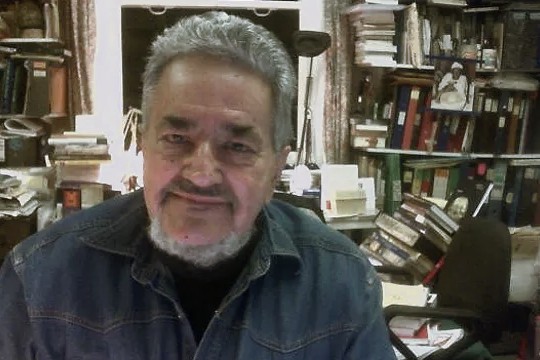
Paulo Fernando de Moraes Farias 1935-2026
Paulo Fernando de Moraes Farias was born in Salvador, Bahia, in 1935. The eldest of four children, he seemed set to follow in his father’s footsteps and become a medical doctor. However, during his time as a student at the School of Medicine at the Federal University of Bahia, Paulo encountered research on Afro-Brazilian culture and history, which inspired him to pursue a different path.
By the time the Bandung Conference was held in 1955, Paulo was about twenty years old, and his political views were firmly to the left. In 1959, he travelled to Europe under the auspices of the International Union of Students to attend a USSR-sponsored international student congress in Vienna, followed by a trip to Moscow, adding visits by boat and train to France, England, Poland, Czechoslovakia, East and West Germany, Italy, Spain, and Portugal. Like other left-leaning intellectuals and politicians, he was excited by the prospect of decolonisation in Africa and the potential for new cultural, economic and political exchanges between Brazil and independent African nations. He believed that an understanding of Africa’s history was essential to challenging the racism that had underpinned slavery and colonialism and continued to damage the futures of African people on the continent and in the diaspora.
Paulo’s career path was reset by an invitation to join the Centre of Oriental and African Studies (CEAO). Established at the Federal University of Bahia in 1959 largely through the initiative of Professor Agostinho da Silva (a fierce critic of the Salazar regime in Portugal), CEAO had developed a relationship with the University of Ghana. Paulo was offered a place on the MA African Studies at the University of Ghana but postponed taking it up because he wanted to participate in the rising anti-government activism in Brazil. After the imposition of the new military dictatorship in 1964, Paulo was the only CEAO researcher who faced an investigation by the state government of Bahia, and his invitation to Ghana had to be quickly reactivated so that he could leave the country. [1]
Under the leadership of Kwame Nkrumah, the Ghanaian government provided hospitality and support for anticolonial activists. While studying at the University of Ghana, Paulo met members of the Angolan and Mozambican liberation movements, as well as Che Guevara. He revelled in the diversity of the students and academics who came from all over Africa and the rest of the world, and in the new intellectual, political, and cultural communities being formed on campus. Having arrived in Ghana as a dissident, however, Paulo did not fail to notice the increasingly authoritarian tendencies of the Nkrumah government. Following the coup in February 1966, he moved on. He was invited to take up a position as researcher at the Institut Fondamental d’Afrique Noire (IFAN) at the University of Dakar, where he stayed for a year before moving to Nigeria to work at Ahmadu Bello University in Zaria for two years (1967-69). While the civil war raged in south-eastern Nigeria, Paulo pursued his research into Islam, an interest initially encouraged by Thomas Hodgkin and Ivor Wilks in Ghana, and subsequently supported by John Hunwick, Abdullahi Smith, Murray Last, and Yusuf Bala Usman in Nigeria.
The years that Paulo spent in West Africa in the late 1960s exposed him to the richness of manuscripts, chronicles, oral traditions, and epigraphy as sources for the study of African history. They also enabled him to meet leading scholars in his field. This laid the foundations for his long and distinguished academic journey, primarily unfolding at the Centre of West African Studies at the University of Birmingham, which Paulo joined in 1969. Here, he introduced students to the broader field of African history, with a particular focus on the history of the West African Sahel and Islam. He also supervised Masters and PhD students from all over the world and pioneered genuinely paradigm-shifting multilingual and cross-disciplinary research.
Paulo’s seminal work, Medieval Arabic Inscriptions from the Republic of Mali, was award the Paul Hair prize by the African Studies Association (USA) in 2005. It had a profound impact on the specialist field of West African medieval history, as well as on important areas of general historical research.[2] These include epigraphic analysis, the exegesis of Arabic sources, and intertextual methods that integrate orally transmitted knowledge with written sources as historical evidence. A key teaching of Paulo, which can be considered foundational to a hermeneutical turn in African history, was to contextualise each type of source within the circumstances of its production. He analysed sources not as ‘windows on the past’, but as texts providing insights into the worldviews and strategies of their authors. Thus, in Medieval Arabic Inscriptions, the Ta’rīkh al-Sūdān does not appear as a disembodied source of raw information, but rather as a partisan text developed by its author, as-Sa’dī. Through his interpretation of Timbuktu’s history, as-Sa’dī reveals a specific political agenda that he shared with others who held similar views.
Paulo studied the Ta’rīkh al-Sūdān alongside oral traditions and epigraphies, taking into account their respective genres and the information they provided about topics such as the reckoning of time and the everyday importance of ancestry. He also considered the meanings attached to the landscapes in which the gravestones bearing the epigraphs were located.[3] He encouraged historians to consider the connections between topography and people’s imagined worlds.[4] Intertextual exegesis enabled him to dispel certain long-held interpretations as myths fuelled by the truth effects of literary conventions.[5]
Paulo developed his work on literary genre, performance, and discourse mostly in collaboration with his wife, Karin Barber, a renowned scholar of Yoruba popular culture. Together, they co-edited volumes that developed a powerful interdisciplinary methodological agenda.[6] They encouraged researchers to apply methods derived from literary criticism to their sources and to reject culturalist approaches that compartmentalise authors within cultural silos. They argued that individuals have the capacity to synthesise different cultural elements and develop original ideological models that draw on a variety of political and cultural influences and idioms. By showing that African history is not ‘African’ in an essentialist sense, this methodology has relevance well beyond African history. It highlights that African history is the result of constant original interactions of African subjects with the world. Sources are undoubtedly the products of their authors’ strategies. However, these strategies combine multiple local, regional, and global discursive influences: ‘Central cultural features were built out of borrowings from other cultures, modified to suit new purposes.’[7] Thus, as Karin and Paulo demonstrate in their scholarship, ‘African history is a history of the world, and a history of the world is African history.’[8]
Paulo’s work is notable for his refusal to treat past authors and performers with the patronising ‘condescension of posterity’. He regarded chroniclers and oral performers as fellow historians and ‘colleagues’.[9] While this analytical position has far-reaching ethical implications, Paulo primarily justified it in scientific terms, demonstrating the loss that occurs when the normative perspectives of past authors are not considered. We owe Paulo what is still one of the most comprehensive analyses of the Almoravid movement.[10] His seminal article, published in 1967, sheds light on the movement’s evolving motivations and objectives.
In recent years, Paulo had started working on African Muslims who, unlike the Almoravids, did not practice jihād. He aimed to portray both jihadist and non-jihadist historical figures as thinkers, rather than as fanatical, poorly educated proponents of ‘jihād of the sword’ motivated by greed (the Almoravids), or as Muslims who were supposedly ignorant of basic tenets of Islam and willing to accommodate ‘pagan’ potentates at any cost (those belonging to the Suwarian tradition). He aimed to prove, instead, that there was much original intellectual activity involved in both cases.[11] Paulo’s own political engagement meant that he was aware that individuals and groups legitimise their political actions by mobilising cultural discourses that precede them and in which they are personally invested. To comprehend political action is to decipher the ideas and acknowledge the cultural toolset available to people, in medieval Africa as in the world today.
Paulo received many honours in the UK and internationally. In 2017, he was elected a Fellow of the British Academy and received the Distinguished Africanist Award from the African Studies Association of the UK. In his home country, he was made a Fellow of the Academia de Letras da Bahia. Following the restoration of democracy in Brazil and Lula’s first government, which made the study of African history compulsory, Brazilian students of African history engaged increasingly with his work. Portuguese translations of his major contributions, published by the Federal University of Bahia, were imminent when he passed away. And yet, Paulo wore his greatness lightly. He was gentle and refined. He listened more than he talked. He observed his fellow humans with a wry twinkle in his eye. He could see others’ weaknesses and flaws, but he considered them with wisdom and kindness. He enjoyed a good cigar and a large rum with coke (full sugar).
Paulo passed away at his home in Birmingham at the age of 90. Until the end, he enjoyed the constant loving and intellectual company of his wife Karin, with whom he shared many interests beyond their joint scholarly work. He will be fondly remembered by family, friends, former students, colleagues, and others as a generous, full-hearted person, calm in his own way after the struggles of his youth: a person who knew well the things that matter in history, and in life.
[1] Luiza Nascimento dos Reis, ‘O exílio africano de Paulo Farias (África Ocidental,1964-1969)’, Tempo (online), Vol. 25 n. 2 (May-August) 2019, 430-52, https://www.scielo.br/j/tem/a/ZgfqwBDYfT56P3KnZZbDCXS/?format=html&lang=pt#
[2] Paulo Fernando de Moraes Farias, Arabic Medieval Inscriptions from the Republic of Mali (Oxford: Oxford University Press for the Fontes Historiae Africanae series of the British Academy, 2003).
[3] Paulo Fernando de Moraes Farias, ‘Text as landscape: cultural reappropriations of medieval inscriptions in the Seventeenth and late Twentieth centuries (Essuk, Mali).’ In O. Hulec & M. Mendel (eds.), Threefold wisdom: Islam, the Arab World, and Africa – Papers in Honour of Ivan Hrbek (Prague, 1993), 53-71.
[4] Paulo Fernando de Moraes Farias, ‘Tadmakkat and the image of Mecca: epigraphic records of the work of the imagination in 11th –Century West Africa’, in T. Insoll (ed.), Case studies in Archaeology and World Religion (Oxford, 1999), 105-15.
[5] For example, Paulo Fernando de Moraes Farias, ‘Silent trade: myth and historical evidence’, History in Africa 1 (1974), 9-24. Similarly, he analysed the appearance of the categories Zanj, Qaqu, and Kawkaw in medieval Arabic sources not as actual groups of people but as categories with discursive and ideological meanings – see idem., ‘Models of the world and categorial models: the ‘Enslavable Barbarian’ as a mobile classificatory label’, Slavery & Abolition 1-2 (1980), 115-31.
[6] Karin Barber and Paulo Fernando de Moraes Farias (eds.), Discourse and its disguises: the interpretation of African oral texts (Birmingham, 1989); Karin Barber and Paulo Fernando de Moraes Farias (eds.), Self-Assertion and brokerage: early cultural nationalism in West Africa (Birmingham, 1990).
[7] Paulo Fernando de Moraes Farias, ‘Bentiya (Kukiya): a Songhay-Mande meeting point, and a ‘Missing Link’ in the archaeology of the West African diasporas of traders, warriors, praise-singers, and clerics’, Afriques: Débats, méthodes et terrains d’histoire, Dossier 04 (2013), 1-59, 30. See also idem., ‘For a non-culturalist History of Béninois Borgu’, in E. Boesen et al. (eds.), Regards sur le Borgou (Paris & Montréal, 1998), 39-69; and idem., ‘Yoruba origins revisited by Muslims: an interview with the Arókin of Òyó and a reading of the ’Asl Qabā’il Yūrubā of Al-Hājj ’Ādam al-Ilūrī’’, in Moraes Farias/Barber (eds.), Self-Assertion and Brokerage.
[8] Toby Green and Benedetta Rossi, eds., Landscapes, Sources, and Intellectual Projects in West African History: Essays in Honour of Paulo Fernando de Moraes Farias (Leiden, 2018), 6. Nigerian edition by Malthouse Press Limited, Lagos, 2020.
[9] Paulo Fernando de Moraes Farias, ‘Praise splits the subject of speech: constructions of kingship in the Manden and Borgu’, in G. Furniss & Liz Gunner (eds.), Power, Marginality and African Oral Literature (Cambridge, 1995), 225-43; Paulo Fernando de Moraes Farias, ‘The oral traditionist as critic and intellectual producer: an example from contemporary Mali’, in T. Falola (ed.), African Historiography (Harlow, 1993), 14-38; and idem.,‘”Cultural Officer” at home and abroad: Oloye Adebayo Ogunrinu Ogundijo, 1939-2005’, Africa 80:1 (2010), 151-8); Paulo Fernando de Moraes Farias, ‘History and consolation: royal Yoruba bards comment on their craft’, History in Africa 19 (1992), 263-97).
[10] Paulo Fernando de Moraes Farias, ‘The Almoravids: Some Questions Concerning the Character of the Movement’, Bulletin de l’IFAN, série B, 29, no. 3–4: 794–878.
[11] Paulo Fernando de Moraes Farias and Benedetta Rossi, ‘Interview: Landscapes, Sources, and Intellectual Projects’ in T. Green and B. Rossi, eds., Landscapes, Sources, and Intellectual Projects in West African History: Essays in Honour of Paulo Fernando de Moraes Farias (Leiden, 2018), 513-16. A video of the interview is accessible here: https://www.youtube.com/watch?v=vkPLWRt22bE
Publications and/or Media
Arabic Medieval Inscriptions from the Republic of Mali (2003)
‘The Almoravids: Some Questions Concerning the Character of the Movement’, Bulletin de l’IFAN, série B, 29, no. 3–4: 794–878
‘Silent trade: myth and historical evidence’, History in Africa 1 (1974), 9-24.
‘Models of the world and categorial models: the ‘Enslavable Barbarian’ as a mobile classificatory label’, Slavery & Abolition 1-2 (1980), 115-31.
‘Bentiya (Kukiya): a Songhay-Mande meeting point, and a ‘Missing Link’ in the archaeology of the West African diasporas of traders, warriors, praise-singers, and clerics’, Afriques: Débats, méthodes et terrains d’histoire, Dossier 04 (2013), 1-59, 30.
‘For a non-culturalist History of Béninois Borgu’, in E. Boesen et al. (eds.), Regards sur le Borgou (Paris & Montréal, 1998), 39-69;
‘Yoruba origins revisited by Muslims: an interview with the Arókin of Òyó and a reading of the ’Asl Qabā’il Yūrubā of Al-Hājj ’Ādam al-Ilūrī’’, in Moraes Farias/Barber (eds.), Self-Assertion and Brokerage.
Toby Green and Benedetta Rossi, eds., Landscapes, Sources, and Intellectual Projects in West African History: Essays in Honour of Paulo Fernando de Moraes Farias (Leiden, 2018), 6. Nigerian edition by Malthouse Press Limited, Lagos, 2020
Collectively authored by Benedetta Rossi, Kate Skinner, Insa Nolte, and Toby Green.