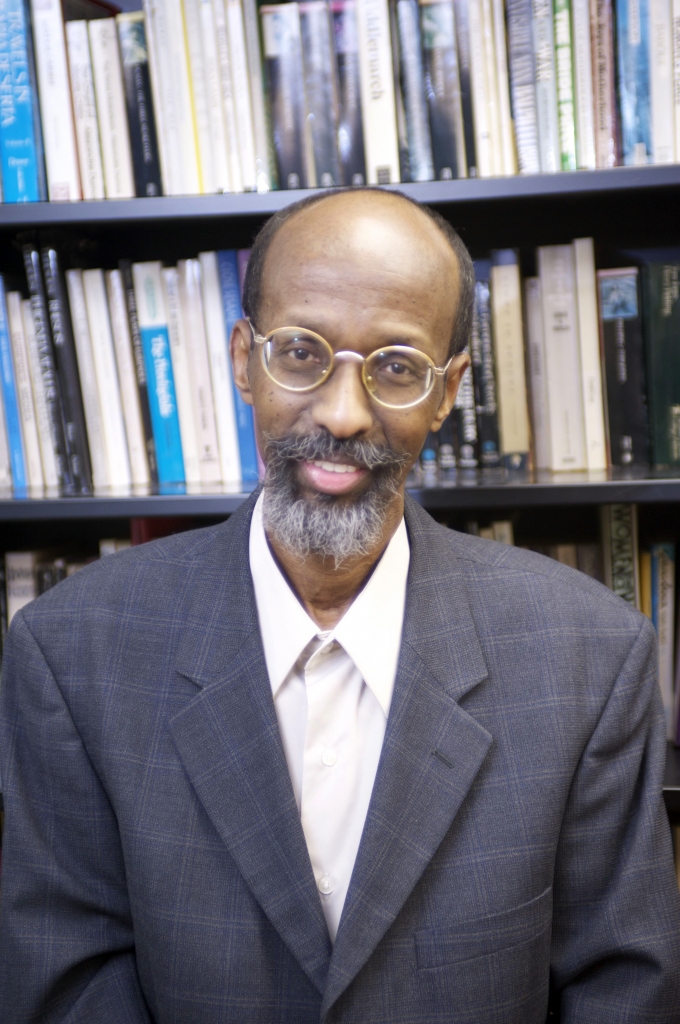
The Somali academic and writer Ali Jimale Ahmed passed away on Tuesday, March 31, in the United States at the age of seventy-one. With his death, the intellectual and cultural life of the Horn of Africa is bereft of one of those rare figures whose work challenged the very language through which a people comes to be understood. There are writers who contribute to a field, and there are others who, by force of epistemological pedagogy and of character, unsettle its inherited premises. Ahmed belonged unequivocally to the latter.
While his work spanned poetry, fiction, criticism, and university teaching, the deeper coherence of his work lay in a sustained endeavour to interrogate the semantic and political construction of “Somalia” as an object of knowledge. His central preoccupation was never merely Somalia as a state, nor even as a society in the ordinary empirical sense, but rather Somalia as a narrated entity – a historical and epistemic formation, repeatedly overdetermined by colonial taxonomies and by the simplifying imperatives of nationalist discourse, both of which obscure the complexity of the questions inherent in Somali society.
He earned his PhD in comparative literature from the University of California, Los Angeles, and later taught at Queens College and the Graduate Center of the City University of New York. His scholarly interests ranged across African and Islamic literatures, oral traditions, poetry, and the difficult commerce between literary expression and political life. Yet however wide the range, one detects throughout his work a remarkable constancy of concern. He returned, again and again, to questions of identity, and narration: by what processes collectivities come to imagine themselves, by what languages they are rendered intelligible to others, and by what acts of naming they are both disclosed and deformed. Such questions, in his hands, were never ornamental abstractions. They were bound up with the fate of actual lives, actual histories, and actual political catastrophes.
Before moving to the United States in the early 1980s, Dr. Ahmed had already established himself within the Somali cultural sphere through journalism and radio. He worked as a contributing editor at Vigilance, then Somalia’s only English-language weekly newspaper, and early on displayed an attentiveness to those communities the dominant social narrative had preferred either to marginalize or to render invisible, particularly artisan groups that had long been relegated to the lower edges of the social hierarchy. At a moment when such questions were not especially welcome in polite public discourse, Dr. Ahmed was already listening for what official language excluded.
On the radio, meanwhile, he hosted a weekly program titled Writing and Writers, in which he introduced audiences to literary texts, including works translated into Somali. Among these was a satirical story by Ngũgĩ wa Thiong’o concerning African elites parading their Mercedes cars amid impoverishment and social decay, which Dr. Ahmed translated into Somali under the title Raggii Mersheedisyada (“Men of Mercedes”). These early interventions now appear, in retrospect, as more than incidental beginnings. They disclose the nascent form of an intellectual disposition that would remain with him throughout his life, a belief that literature is not a decorative appendage to social life but one of its most searching diagnostics, that culture does not merely mirror society but registers its concealed hierarchies, its evasions, and its bad faith – and that to attend to the marginalized is, in the strictest sense, to attend to the unfinished truth of the social order.
Dr. Ahmed arrived in New York on December 30, 1982, and began graduate study the following year. He went on to complete both his master’s and doctoral degrees at UCLA, where he also served as editor-in-chief of Ufahamu from 1987 to 1989. It was during this period that the architecture of his mature intellectual project came more fully into view. That project joined theoretical discipline to historical inquietude, it combined rigorous training in comparative literature with a return to what might be called the Somali question. Yet he did not approach that question as a mere national case study, still less as a tableau of African dysfunction to be explained by familiar developmental and anthropological scripts. He approached it as a historical, cultural, and epistemic knot – a dense formation in which questions of language, power, memory, and representation had become inseparable from the crisis of statehood itself.
What distinguished Ahmed was that he shifted the level at which the questions were posed. Much writing on Somalia and Somalis in general, especially in the decades surrounding state collapse, had been content to ask why the state failed, and in so doing often presupposed that the object under examination was already self-evident. Dr. Ahmed, by contrast, turned inquiry back upon its own terms. He sought to dismantle the conceptual habits through which “Somalia” had been produced within both colonial and nationalist knowledge systems. This was, in the deepest sense, a semantic and historiographical intervention. For him, the issue was not merely whether Somalia had been misgoverned, but how it had been imagined into legibility; not merely what had happened to the nation-state, but how the nation itself had been discursively assembled, by whom, and at what cost. In his work, the question “What is Somalia?” was never innocent, because the predicate concealed prior struggles over naming, authority, and historical admissibility.
If one work may be said to crystallize this intellectual wager, it is his best-known volume, The Invention of Somalia. The title itself is revealing. It does not suggest, in any frivolous or nihilistic sense, that Somalia was fictitious; rather, it insists that modern Somalia must be understood as historically produced and discursively mediated. The nation, in this formulation, is not a primordial given but a constructed object, shaped through colonial administration, nationalist myth, scholarly classification, and uneven structures of inclusion and exclusion.
The book became a landmark in Somali studies precisely because it challenged the language of the debate itself. Dr. Ahmed challenged those coarse explanatory reflexes that reduced Somali collapse to “tribe,” as though the invocation of clan could substitute for analysis. He revisited entrenched assumptions concerning ethnic homogeneity, the origins of Somali identity, the role of Islam, the history of the Benadir coast, the representation of women, and the conditions of Bantu communities. In so doing, the volume displaced the conventional question, “Why did the state fail?” and replaced it with a more perturbing inquiry: how was Somali identity historically constituted, and who acquired the power to define it as coherent, authentic, and normative?
This movement from event to discourse, from crisis to conceptual formation, is crucial to understanding Dr. Ahmed’s significance. He was among the few Somali intellectuals of his generation to see clearly that political catastrophe is rarely only political. It is also semantic. Societies do not simply collapse institutionally – they are often first narrowed, simplified, and misrecognized in language. Dr. Ahmed’s work can therefore be read as an extended struggle against semantic closure, against the reduction of a historically layered society into a single anthropological key, against the freezing of fluid identities into static categories, against the conversion of provisional descriptions into metaphysical truths.
From this same horizon of inquiry emerged Daybreak Is Near: Literature, Clans, and the Nation-State in Somalia, a work whose roots lay in his 1989 UCLA dissertation on Somali oral literature and the fiction of Nuruddin Farah. Dr. Ahmed advanced one of his most fertile methodological claims – that literature is not merely reflective but cognitive, not simply expressive but diagnostic. He read literary texts as repositories of social contradiction, as sites in which the tensions of the nation-state become thinkable before they become administratively visible. In this view, poetry, fiction, and oral literature do not stand outside political life, prettifying it from a distance. They form part of its interior archive. They register anxiety, fracture, resentment, and disillusion in ways that institutional discourse often cannot.
Yet Dr. Ahmed was never a romantic of literature in the “cheap sense,” nor was he one of those critics who attribute all African tragedy to the afterlife of colonialism and stop there. He was far too severe, and far too intellectually honest, for such consolations. If he rejected colonial tropes, he also refused the alibi of total externalization. His critique was double-edged. He remained critical of international policies and of the brutal consequences of foreign intervention, and he spoke forcefully against measures such as the American travel ban, which he regarded as an additional punishment imposed upon a population already devastated by war and bombardment.
Reacting to Trump travel ban, which many critics viewed as an inherently anti-immigration policy, Dr. Ahmed said, “We live in a strange world, where it is easy to attack and demonize your enemy, and where it is even easier to target those who are already vulnerable, like Somalia.” However, he was equally insistent that Somalia’s tragedy could not be explained solely by external forces. He rejected both external determinism and claims of internal innocence.
This doable criticism appears with particular force in his reflections on the civil war. He recounted that, after the fall of Siad Barre’s regime, he heard someone from within his own clan environment say, “Now we are in power.” What arrested him in that moment was not only the sentiment itself, but the political grammar and language it disclosed. The statement condensed an entire theory of authority — power conceived not as a civic trust, nor as the institutional expression of shared membership, but as possession — transferable, monopolizable, and fundamentally exclusionary.
Dr. Ahmed grasped at once that a polity founded on such a semantics of dominance could not yield a nation in the modern civic sense. And true to his character, he did not exempt his own milieu from criticism. He assigned actors within his own clan a share of responsibility for the destruction of Mogadishu and called instead for the building of an inclusive national center broad enough to accommodate the historically marginalized, including Bantu communities. This, perhaps, marks one of the finest aspects of his moral stance, he did not flatter his own people, nor did he shelter beneath the consoling rhetoric of collective victimhood. He demanded that accountability begin at home, not because external violence was unreal, but because moral seriousness requires the courage to name complicity where it is nearest.
Alongside his academic criticism, Dr. Ahmed sustained a substantial literary practice that gave emotional density and symbolic form to the questions that preoccupied his scholarship. His poetry collections — Fear Is a Cow (2002), Diaspora Blues (2005), and When Donkeys Give Birth to Calves: Totems, Wars, Horizons, Diasporas (2012) — explore fear, exile, fragmentation, historical absurdity, and the psychic afterlives of war. These books should not be read as ancillary to the scholarly work, as though the poems merely ornamented ideas elsewhere stated in prose. They are better understood as another register of the same inquiry. Where the criticism anatomized the languages of power and the discursive production of identity, the poems moved closer to what such abstractions feel like from within: the estrangement of displacement, the distortion of memory, the uncanny normality of catastrophe.
His co-edited volume The Road Less Travelled: Reflections on the Literatures of the Horn of Africa (2008) further widened his scope by situating Somali writing within a broader regional and comparative horizon. This, too, was characteristic. Dr. Ahmed never allowed Somali literature to be provincialized, nor did he permit the Horn of Africa to remain conceptually subordinate to larger and more fashionable geographies of criticism. He understood that canon formation is itself a politics of visibility, and that to edit, curate, and interpret the literatures of the region was to intervene in the hierarchy of what the world is prepared to regard as intellectually central. He later published the Somali-language novel Gaso, Ganuun, and Gasiin, which Queens College described as a distinctive experiment in the relatively short history of the Somali novel.
In the end, Dr. Ali Jimale Ahmed leaves behind more than a bibliography, though the bibliography itself is formidable. He leaves a manner of reading, a discipline of skepticism, and a mode of intellectual seriousness that has become increasingly rare. His writing resists simplification. He understood that societies wounded by violence are also wounded by the vocabularies through which they are flattened, and explained. To read him is to encounter a mind impatient with lazy causality, alert to semantic coercion, and unwilling to separate critique from ethical risk. He combined the sensibility of a poet, the precision of a critic, the discipline of a scholar, and the agitation of a public intellectual who knew that analysis, if it is to be worthy of the name, must begin by distrusting its own habitual terms. Even in exile, even when writing under the long shadow of war and displacement, he continued to defend the possibility that Somalis might recover the right not only to narrate their collective life, but to contest the very language in which that life had too often been imprisoned.
Authored by Suhaib Mahmoud, Submitted by Kathleen Sheldon