

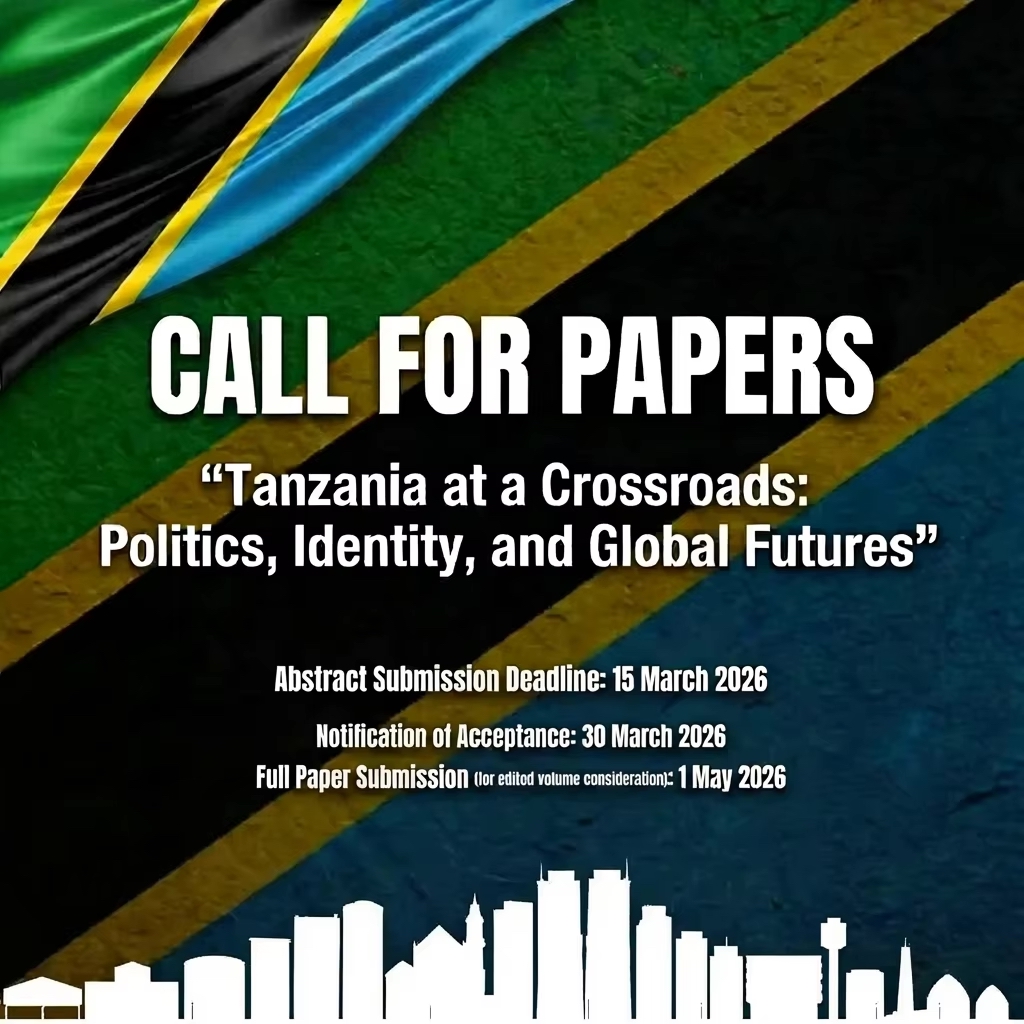
CALL FOR PAPERS
Virtual Interdisciplinary Conference
Tanzania at a Crossroads: Politics, Identity, and Global Futures
Introduction
We invite submissions from scholars across the humanities and social sciences for a virtual interdisciplinary conference examining Tanzania’s current political moment from both local and global perspectives. This conference will explore the profound transformations shaping the United Republic of Tanzania—a nation navigating accelerating geopolitical realignments, contested electoral processes, evolving constitutional arrangements, and competing visions for its future. Selected papers will be published in an edited volume.
The October 2025 general elections marked a watershed moment in Tanzanian political history. With major opposition parties barred from participation and unprecedented levels of electoral violence, the polls have raised fundamental questions about democratic governance, civic participation, and the trajectory of political development in East Africa’s largest nation. These domestic developments unfold against a backdrop of intensifying great power competition, as Tanzania charts its course between the gravitational pulls of Beijing and Washington while seeking to maintain the non-aligned posture that has characterized its foreign policy since independence.
This conference seeks rigorous, theoretically grounded, and empirically informed scholarship that illuminates Tanzania’s place in the contemporary world order and the internal dynamics reshaping its polity and society.
Conference Themes
We welcome papers addressing, but not limited to, the following themes:
1. Geopolitics and Tanzania’s Place in the World
- How is Tanzania navigating the intensifying geopolitical competition between the United States and China?
- What role does Tanzania’s revised foreign policy (2024) play in positioning the country within South-South cooperation frameworks?
- How do Belt and Road Initiative projects, TAZARA modernization, and Chinese investment shape Tanzania’s development trajectory and sovereignty?
- What are the implications of Tanzania’s non-alignment tradition in an era of renewed great power rivalry?
- How does Tanzania’s membership in regional blocs (EAC, SADC) influence its global positioning?
2. Elections, Democratic Governance, and Political Development
- What do the 2025 elections reveal about the state of multiparty democracy in Tanzania?
- How did the exclusion of major opposition parties and subsequent electoral violence reshape the political landscape?
- What explains the trajectory from President Hassan’s initial “4Rs” reform agenda to the consolidation of CCM’s dominance?
- How do local government elections (2024) and national elections (2025) reflect patterns of electoral authoritarianism?
- What lessons does Tanzania offer for comparative studies of democratic backsliding in Africa?
3. The Union Question: Tanganyika, Zanzibar, and Constitutional Futures
- What is the current state of the sixty-year union between mainland Tanzania and Zanzibar?
- How do tensions over resource allocation, political representation, and sovereignty manifest in contemporary union politics?
- What are the implications of President Hassan’s Zanzibari identity for union dynamics and mainland-island relations?
- How do calls for constitutional reform—including proposals for a three-tier government structure—reflect evolving conceptions of Tanzanian federalism?
- What role does religious identity play in union politics, particularly given Zanzibar’s Muslim majority?
4. Emerging Constituencies and Civil Society
- What new political constituencies have emerged in contemporary Tanzania, and how are they shaping political discourse?
- How has Generation Z mobilized in response to political exclusion and economic marginalization?
- What role does the Tanzanian diaspora play in political activism, remittances, and development?
- How are digital platforms, social media, and online organizing transforming political participation despite state restrictions?
- What is the state of civil society, journalism, and human rights advocacy under current conditions?
5. Economic Development, Resources, and Inequality
- How do megaprojects (hydropower, standard gauge railway, port development) shape Tanzania’s economic future?
- What are the implications of gold exports, critical mineral extraction, and natural resource governance for development?
- How do land disputes—including Maasai displacement from Ngorongoro—reflect tensions between conservation, investment, and indigenous rights?
- What explains the paradox of robust economic growth alongside persistent poverty?
- How do foreign direct investment patterns and investor confidence coexist with democratic erosion?
6. Internal and External Pressures on Policy
- How do international human rights frameworks and foreign government responses influence Tanzanian policy?
- What internal pressures—from within CCM, the security apparatus, and regional power centers—shape governance?
- How do patterns of enforced disappearances, arbitrary detention, and extrajudicial violence reflect the security state’s consolidation?
- What role do regional dynamics—instability in neighboring countries, EAC integration—play in domestic policy?
- How does Tanzania’s climate vulnerability and blue economy potential shape environmental and development policy?
7. Visions and Futurisms: Imagining a Better Tanzania
- What alternative political, economic, and social visions are Tanzanians articulating for their nation’s future?
- How do artists, intellectuals, and activists imagine post-CCM political arrangements?
- What role does Ujamaa’s legacy play in contemporary debates about socialism, development, and African alternatives to neoliberalism?
- How might Tanzania’s unique history of stability and peaceful transfers of power inform pathways to democratic renewal?
- What do Afrofuturist, Pan-African, and East African integrationist perspectives offer for imagining Tanzania’s trajectory?
Submission Guidelines
We welcome submissions in the following formats:
- Individual Paper Abstracts: 300–500 words, including title, research questions, methodology, and preliminary findings.
- Panel Proposals: A 200-word panel rationale plus 300-word abstracts for 3–4 papers, with identified chair and discussant.
- Roundtable Proposals: 500-word description of theme and format, with 4–6 confirmed participants.
All submissions should include:
- Author name(s), institutional affiliation, and contact information
- A brief biographical statement (100 words)
- 5–7 keywords
- Indication of any audio-visual requirements
Key Dates
Abstract Submission Deadline: 15 March 2026
Notification of Acceptance: 30 March 2026
Full Paper Submission (for volume consideration): 1 May 2026
Virtual Conference Date: 15 June 2026
About the Edited Volume
Selected papers from the conference will be developed for publication in an edited volume. Contributors whose abstracts are accepted will be invited to submit full papers (7,000–9,000 words) for peer review. The volume will be proposed to leading academic presses specializing in African studies and political science.
Conference Organizers and Volume Editors
Dr. Cliff “Ubba” Kodero, Morgan State University Email: cliff.kodero@morgan.edu]
Dr. Iqbal Akhtar Associate Professor, Religious Studies and Politics & International Relations Florida International University Director, Western Indian Ocean Studies
Phillip Lwiza Phd Student, International Relations Florida International University
Submission Instructions
Please submit all materials electronically to Phillip Lwiza <plwiz001@fiu.edu> with the subject line: “Tanzania Conference Submission: [Your Last Name].” For questions, contact any of the conference organizers.
Note: This conference welcomes scholars at all career stages, including advanced graduate students. We particularly encourage submissions from scholars based in Tanzania, East Africa, and the broader Global South.
